
Phone
Houston: (832) 548-3972....... New Orleans: (832) 548-3972..........Orlando: (321) 355-6052
Phone
Recent studies of coastal high-rise structures have documented unexpected subsidence ranging from two to eight centimeters, proving that a building’s footprint is rarely as static as it appears. For property owners, observing new wall fissures or misaligned door frames often triggers a justified anxiety regarding structural integrity, particularly as the 2026 deadlines for SB-4D Milestone Inspections draw near. It’s understandable to feel caught between the fear of catastrophic failure and the potential for overwhelming repair costs.
This guide offers a disciplined framework for evaluating settling foundation issues by moving beyond surface-level symptoms to address the underlying geotechnical and structural relationship. You’ll gain a thorough understanding of the forensic methods used to determine if movement is a normal occurrence or a genuine threat to stability. We will examine the geological drivers unique to Florida’s limestone terrain, the specific forensic indicators required for valid insurance claims, and the professional standards, such as ASTM E3176-24, that ensure your building remains a secure and compliant asset.
Foundation settling refers to the vertical displacement of a structure resulting from the consolidation of underlying soil strata. While a degree of movement is anticipated in every new construction project, the scale and complexity of commercial assets demand a rigorous approach to evaluating settling foundation performance. In high-occupancy or multi-family environments, the margin for error is significantly narrower than in residential design. Structural due diligence serves as a critical risk management tool, ensuring that minor geological shifts don’t evolve into systemic failures. Engaging a Forensic Structural Engineer allows property owners to move beyond visual observations and into quantitative analysis that protects both the asset and its occupants.
Uniform settlement occurs when the entire foundation subsides at an equal rate, effectively maintaining the building’s equilibrium. Even if the structure sinks several centimeters, the lack of relative movement between structural members often prevents visible damage. Differential settlement, however, is a primary driver of structural distress. This occurs when distinct sections of the foundation move at varying rates or depths, often due to non-uniform soil bearing capacities across a large building footprint.
The mechanics of differential movement introduce intense shear forces and bending moments into the building frame. Concrete is inherently strong in compression but exceptionally weak in tension. When one corner of a building drops, it creates tensile stresses that exceed the concrete’s capacity. While steel reinforcement is designed to manage these loads, excessive movement can lead to yielding, causing visible fractures and compromising the load-path continuity of the entire structure.
Florida’s unique subsurface conditions present specific challenges for maintaining foundation stability over time. The state’s geology is characterized by several factors that complicate the process of evaluating settling foundation issues:
Understanding these geological drivers is essential for distinguishing between expected building behavior and an active structural threat. Without a forensic perspective, property managers risk applying superficial repairs to symptoms that are actually indicators of deep-seated geotechnical instability.
Visual diagnostics represent the initial phase in evaluating settling foundation stability. While surface fissures are common in aging structures, their morphology reveals the underlying stress state of the building. Engineers rely on established technical guidelines, such as the USACE Settlement Analysis Manual, to correlate these visual markers with geotechnical data. The objective isn’t just to document the existence of a crack, but to interpret the specific force that generated it.
Stair-step cracks following mortar joints in masonry are classic indicators of differential settling. These patterns emerge when the foundation lacks uniform support, forcing the wall to “step” down to follow the soil’s movement. The orientation of the crack is equally telling. A crack that is wider at the top suggests the foundation is rotating outward or the center of the building is experiencing heave. Conversely, a crack wider at the bottom typically indicates a downward drop at that specific location. Shear cracks are a primary indicator of foundational shear failure, representing a critical loss of structural capacity.
The standard “Rule of Thumb” often suggests that cracks exceeding 1/4 inch warrant immediate investigation. However, professional evaluation prioritizes the rate of change over a single snapshot. A hairline crack that expands by 2 mm over three months is far more concerning than a static 1/2-inch crack that hasn’t moved in a decade. Monitoring this progression is vital for determining if the settlement is active or has reached a state of equilibrium.
Racking of the building frame often manifests as misaligned windows and doors. When the foundation shifts, the rectangular openings for these components become parallelograms, causing sticking, latch failure, or visible gaps in the trim. Floor slope is another quantifiable metric used during a forensic investigation. Engineers measure this in inches per foot; a slope exceeding the L/240 limit of the span often indicates significant foundation rotation that requires remediation.
In high-rise commercial assets, secondary symptoms can include elevator guide rail misalignment or recurring plumbing leaks in vertical stacks. These issues arise when the building’s core undergoes non-uniform vertical displacement, placing strain on rigid mechanical systems. If you observe the separation of building components, such as balconies or chimneys pulling away from the main building envelope, it’s time to seek a comprehensive forensic assessment to verify the asset’s structural safety.
While identifying crack morphology is vital for documentation, understanding the environmental drivers behind these shifts is essential for evaluating settling foundation performance accurately. Florida’s high-energy weather patterns and unique subterranean architecture create a highly dynamic environment for commercial footings. External factors often act as catalysts; they accelerate latent soil issues that might otherwise remain dormant for decades. Recognizing these triggers allows property managers to transition from reactive repairs to proactive risk mitigation.
Severe weather events, particularly the intense precipitation associated with Atlantic hurricane seasons, can trigger hydro-consolidation. This phenomenon occurs when dry, loosely packed soils undergo sudden saturation, causing the soil structure to collapse and the building load to shift abruptly. This isn’t a slow consolidation process. It’s a rapid loss of volume that can lead to immediate structural distress in multi-family and commercial assets.
Latent settling is also frequently triggered by external mechanical energy. Nearby heavy construction, piling installations, or seismic vibrations from high-traffic corridors can disturb established soil-to-foundation bonds. Biological factors play a role as well. Invasive tree roots can desiccate clay-bearing soil layers by extracting moisture, leading to localized shrinkage and uneven support. When these environmental pressures converge, the structural integrity of the foundation depends entirely on the geotechnical stability of the site.
Florida’s high water table is rarely static. The “pumping” effect occurs as groundwater levels rise and fall, repeatedly wetting and drying the soil beneath footings. This cycle can weaken soil cohesion and lead to the erosion of support material, especially in sites with deficient drainage systems. Poor site drainage allows water to pool near the foundation, saturating the soil and reducing its effective bearing capacity. This saturation allows the foundation to sink into the softened substrate, often resulting in the differential movement discussed in previous sections.
In regions like Orlando and Tampa, the underlying karst topography introduces a layer of unpredictability. This landscape is defined by soluble limestone bedrock that dissolves over time when exposed to acidic rainwater. As the limestone erodes, it creates subsurface voids. When a commercial structure’s weight exceeds the capacity of the soil bridging these voids, sudden settlement or localized failure occurs. Precise geotechnical testing is mandatory in these areas to confirm soil bearing capacity and identify potential anomalies before they compromise the asset’s integrity. This technical oversight ensures that the foundation is designed for the reality of the terrain rather than theoretical averages.
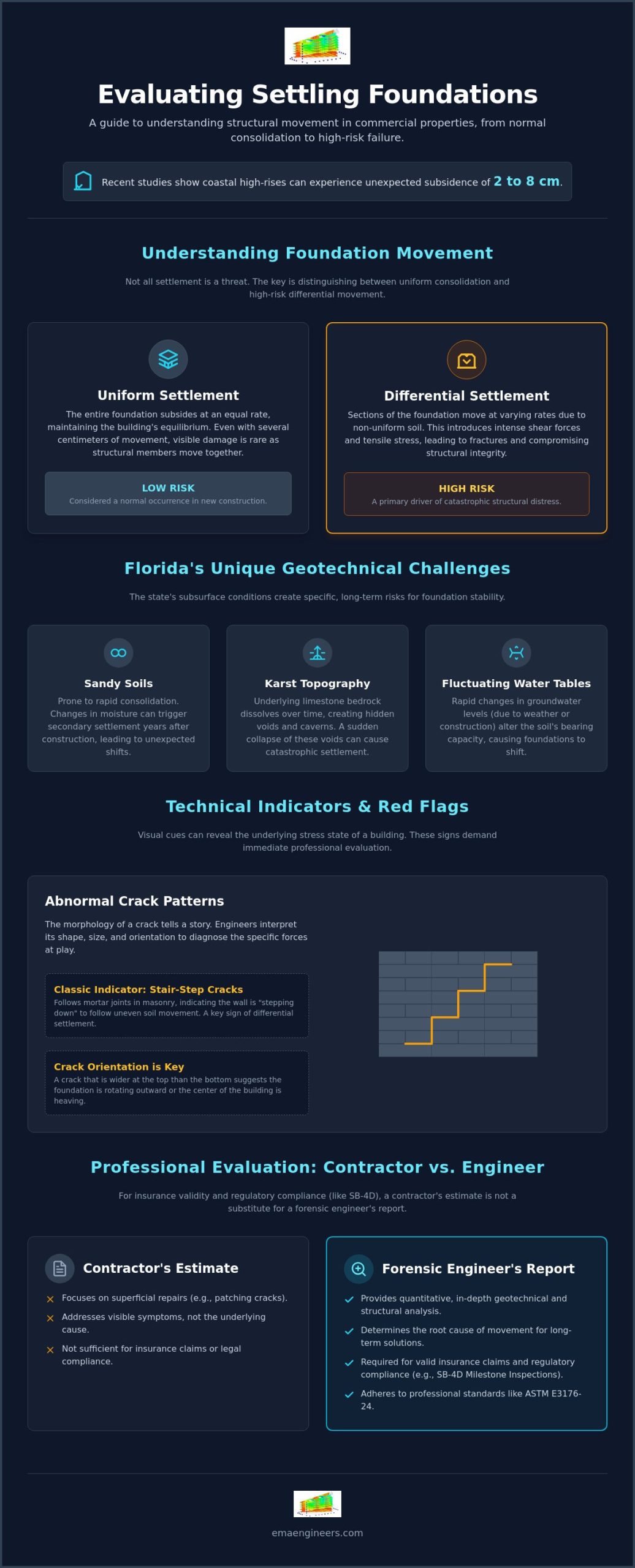
The methodology for evaluating settling foundation performance in high-stakes commercial environments is fundamentally different from a standard contractor’s inspection. While a contractor’s quote serves as a proposal for remediation, a licensed engineer’s forensic report is a disciplined, objective document designed to determine causation and liability. This distinction is vital for insurance claim validity and regulatory compliance under Florida’s SB-4D requirements. A proper forensic investigation adheres to standards like ASTM E3176-24, beginning with a comprehensive data collection phase where historical records, original site plans, and previous soil surveys are analyzed to establish a baseline for the building’s performance.
Engineers utilize specialized equipment to quantify structural movement with clinical precision. Floor manometers, or high-precision water levels, create topographic maps of interior slabs to reveal elevation changes that are often invisible to the naked eye. Crack monitors are installed to track ongoing displacement with sub-millimeter accuracy, providing the temporal data needed to differentiate between historic and active movement. This data-driven approach allows for the implementation of non-destructive testing (NDT) to evaluate foundation depth and integrity without compromising the existing structure.
The initial phase involves mapping every visible fissure within the structure to identify global movement trends. This is not a mere inventory of cracks; it’s a spatial analysis that correlates damage across different floors and building faces. Engineers use high-precision laser levels to check the building’s “plumb,” identifying any lean or rotation in the vertical columns that could suggest a deep-seated foundation issue. The building envelope is also scrutinized for signs of stress, such as breached expansion joints or sealant failure, which often precede more significant structural indicators.
When movement is suspected to be active, crack gauges are mounted across key fractures to monitor displacement over time. These instruments provide the objective evidence required to determine if the settlement has reached equilibrium or if it requires immediate structural intervention. Ground Penetrating Radar (GPR) is frequently deployed to scan for subsurface voids or anomalies in the concrete slab that might suggest soil loss or karst activity. To verify the bearing capacity of the substrate, Standard Penetration Testing (SPT), conducted under ASTM D1586, measures soil resistance by recording the number of blows required to drive a sampler into the ground. If your asset shows signs of distress, it’s essential to schedule a forensic engineering evaluation to secure a definitive, evidence-based resolution.
Engaging a forensic structural engineer is a strategic decision that shifts a property owner’s position from technical uncertainty to documented clarity. While minor cosmetic cracking is common, certain “red flags” signal a requirement for immediate professional oversight. These include fractures that penetrate the entire depth of the building envelope, rapid expansion of existing fissures, or the visible separation of secondary structures such as balconies and chimneys. In these high-stakes scenarios, evaluating settling foundation performance requires a licensed expert to move from visual observation to legal and structural certainty.
For insurance claim resolution, a forensic report is a legal necessity. It provides the only definitive, unbiased cause-of-loss determination that adjusters and legal professionals recognize as valid evidence. This level of professional evaluation protects long-term property value by ensuring that any remediation addresses the root cause rather than superficial symptoms, effectively reducing future liability for the owner. A forensic report doesn’t just identify damage; it establishes a clear path toward structural stability and financial recovery.
Florida’s legislative environment has undergone significant shifts with the introduction of SB-4D. This law mandates Milestone Inspections for multi-family residential buildings, including condominiums and cooperatives, that reach three stories in height. Evaluating settling foundation stability is a core component of the Phase One Milestone Inspection. This process determines if the building is structurally sound for its continued use. Ignoring signs of structural distress under current Florida law can lead to severe penalties, including the potential loss of a building’s certificate of occupancy if it’s deemed unsafe. As we move through 2026, many buildings will face critical deadlines for these mandatory structural assessments, making early detection and engineering intervention a regulatory priority.
Once a forensic evaluation is complete, the engineer provides a precise “Scope of Work.” This document serves as the technical blueprint that general contractors must follow during remediation, ensuring the repair meets specific engineering standards. Common engineering-led solutions include the installation of helical piers to transfer building loads to deeper, more stable soil strata or the use of chemical grouting to stabilize loose soils through injection. This ensures that the repair is structurally sound and verified by a third-party expert rather than a contractor with a vested interest in the repair volume. To ensure your commercial or multi-family asset remains compliant and structurally secure, Consult with EMA Forensic Engineers for a comprehensive structural assessment.
Navigating the complexities of subsurface soil movement requires a transition from reactive observation to disciplined engineering analysis. Differentiating between expected soil consolidation and high-risk differential movement is the first step in protecting a commercial asset’s value. As Florida’s environmental pressures and SB-4D regulatory deadlines converge, the technical precision used in evaluating settling foundation performance becomes a primary safeguard against structural failure and legal liability.
EMA Structural Forensic Engineers provides the objective data and forensic oversight necessary to resolve high-stakes foundation challenges. With over 40 years of experience in Florida’s unique infrastructure landscape, our state-licensed structural and forensic engineers specialize in the Milestone and HUD foundation inspections required for modern compliance. We deliver the definitive cause-of-loss determinations that insurance providers and regulators demand. Don’t leave your building’s stability to chance. Schedule a Forensic Foundation Evaluation with EMA Structural Forensic Engineers to ensure your property remains a secure, high-performing asset for years to come.
While initial soil consolidation typically concludes within the first decade of a building’s life, new settlement in older structures is often triggered by external environmental changes. Fluctuations in the groundwater table, nearby heavy construction vibrations, or the slow dissolution of underlying limestone can re-initiate movement. It’s not considered a standard stage of aging; rather, it’s a response to a specific catalyst that requires a professional forensic investigation to identify the root cause.
Cosmetic cracks are generally hairline fissures that follow drywall tape joints or appear at the corners of doors and windows due to seasonal thermal expansion. In contrast, foundation-related cracks often exceed 1/8 inch in width and penetrate the structural substrate. When evaluating settling foundation indicators, engineers look for stair-step patterns in masonry or diagonal fractures that coincide with door frame misalignment, as these suggest active structural displacement rather than superficial shrinkage.
A professional forensic report provides a site plan, topographic elevation surveys, and detailed crack mapping to establish the building’s current state. It must adhere to standards like ASTM E3176-24, documenting the specific methodology used for analysis and providing a definitive cause-of-loss determination. This document serves as the primary technical evidence required by insurance carriers to differentiate between excluded wear and tear and covered perils like sudden soil collapse.
No, foundation settlement and sinkhole activity are distinct geological events, although they can be related. Most settlement is the result of soil consolidation, poor site drainage, or erosion of the support strata. While karst topography can lead to sinkholes that cause catastrophic settlement, a forensic assessment is necessary to determine if the movement is localized to the foundation footings or indicative of broader subsurface cavernous activity.
Acceptable movement is dictated by the building’s specific design and the L/240 or L/360 deflection ratios defined in the Florida Building Code. While vertical subsidence is often anticipated in design, horizontal displacement is far more critical as it suggests lateral earth pressure issues or shear failure. Any horizontal shift that causes the misalignment of structural columns or breaches expansion joints requires immediate intervention from a licensed structural engineer.
Remediation strategies depend entirely on the identified cause of movement. If the settlement is driven by hydro-consolidation from poor drainage, correcting water runoff and improving site grading may stabilize the structure. In other cases, chemical grouting can be used to densify loose soils at a lower cost than traditional underpinning. However, these decisions must be guided by a “Scope of Work” developed by a forensic engineer to ensure long-term stability.
During a Phase One Milestone Inspection, the engineer performs a disciplined assessment of the building’s primary structural members to verify safety for continued occupancy. Their primary responsibility involves evaluating settling foundation performance and identifying signs of “substantial structural distress” as required by Florida SB-4D. If significant issues are found, the forensic engineer provides the technical justification for a more intensive Phase Two investigation.
Standard property insurance policies typically exclude damage resulting from “normal” settlement, earth movement, or hydrostatic pressure. However, coverage may be available if the settlement is a direct consequence of a covered peril, such as a sudden internal plumbing failure or specific sinkhole activity. A forensic engineering report is essential in these cases to provide the objective, evidence-based cause-of-loss determination needed to validate a claim with the insurance carrier.