
Phone
Houston: (832) 548-3972....... New Orleans: (832) 548-3972..........Orlando: (321) 355-6052
Phone

Structural Engineering Consultants provide complete requirements and services performed by EMA Structural Forensic Engineers covering Houston, Corpus Christi, Victoria, Austin, Beaumont, New Orleans, Lake Charles. A building is more than an architectural achievement. It’s a complex assembly of forces that must withstand the specific environmental rigors of the Florida landscape. For property owners and developers, the distinction between a general contractor and specialized structural engineering consultants often represents the difference between a catastrophic structural failure and long-term stability. You likely recognize that the pressure to meet stringent requirements and the upcoming Building Code creates a significant burden of technical responsibility. The anxiety surrounding hidden damage or non-compliance is a rational response to an increasingly complex regulatory environment.
This guide demonstrates how professional structural engineering consultants safeguard your investment through rigorous forensic analysis and precise technical oversight. We’ll define the professional scope of these experts, detail the necessity of milestone inspections, and provide the clarity needed to manage the state’s safety laws with confidence. By understanding the disciplined approach of a structural engineer, you can ensure your property remains a secure, compliant, and functional asset for decades to come.

A structural engineering consultant serves as a licensed technical authority responsible for the stability and safety of the built environment. They operate as disciplined partners who apply the rigorous principles of Structural engineering to ensure that every component of a building can withstand the physical forces exerted upon it. These professionals utilize advanced materials science and physics to calculate precise load-bearing capacities. They must account for static loads, such as the weight of the building materials themselves, and dynamic loads, which include hurricane-force winds or the weight of occupants. Their involvement provides a layer of objective oversight that remains independent of the aesthetic goals of an architect or the timeline constraints of a general contractor.
The primary objective of structural engineering consultants is the preservation of public safety and the protection of the property owner’s financial interests. A structural failure is rarely a singular event. It’s often the result of cumulative oversights in design or maintenance that aggregate over time. By conducting thorough analyses, these consultants identify potential points of failure before they manifest as costly repairs or dangerous collapses. This methodical approach ensures that the physical infrastructure remains resilient against Florida’s unique environmental challenges, including high humidity and corrosive salt air. It’s about maintaining functional excellence through clinical precision.
While both professionals are vital to building development, their core focuses diverge significantly. Architects prioritize the spatial experience, focusing on aesthetics, interior flow, and how a user interacts with the space. In contrast, structural engineering consultants focus exclusively on the “bones” of the building. They design the foundation, framing, and load-transfer systems that allow the architect’s vision to stand. A successful project requires seamless collaboration; the engineer ensures the architectural design is physically viable without compromising the building’s structural integrity. They provide the technical framework that makes the aesthetic vision possible.
Determining when to engage structural engineering consultants is critical for effective risk mitigation. Their expertise is required at several pivotal stages of a building’s lifecycle:
Engaging a consultant early prevents the escalation of minor issues into structural emergencies. It’s a proactive investment in the long-term stability of the asset.
The professional scope of structural engineering consultants encompasses the entire lifecycle of a building, from its conceptual inception to the resolution of complex structural failures. At the design phase, these experts develop the critical blueprints for foundations, framing, and roofing systems. This work involves precise calculations to ensure compliance with the Structural Engineering Institute (SEI) standards and the Florida Building Code. By establishing a robust technical framework early, consultants prevent the structural deficiencies that often lead to long-term liability and safety concerns.
While design services focus on creation, forensic engineering focuses on discovery. This discipline involves “reverse engineering” a failure to identify its root cause with clinical precision. Whether a property owner is dealing with hurricane damage or unexplained foundation settling, forensic specialists provide the analytical clarity required to determine if a failure resulted from design errors, material defects, or environmental degradation. For those managing aging assets, securing a professional forensic engineering evaluation is a vital step in protecting the physical and financial integrity of the property.
Forensic structural investigations performed by structural engineering consultants are essential when a structure fails to perform as intended. This includes analyzing structural collapses, chronic water intrusion, or the premature degradation of reinforced concrete in coastal environments. Consultants utilize non-destructive testing (NDT) methods to evaluate internal structural health without causing further damage to the building envelope. These findings are often used to provide expert witness testimony in legal disputes or to substantiate complex insurance claims. The goal is to move beyond surface-level symptoms to find a definitive technical resolution.
Inspection services have become increasingly rigorous following legislative shifts in Florida. Professional structural engineering consultants conduct building structural integrity inspections to identify latent defects that may not be visible to the untrained eye. This includes:
These inspections aren’t merely bureaucratic hurdles. They’re disciplined safety protocols designed to catch minor vulnerabilities before they escalate into life-threatening failures. By adhering to these rigorous standards, property owners demonstrate their commitment to the long-term safety of their occupants and the preservation of their investment.
Florida’s geographical and legislative environment creates a high-stakes landscape for property owners. Unlike more temperate regions, the state’s proximity to the coast and its susceptibility to extreme weather events demand a specialized application of Structural engineering. Structural engineering consultants operating in this region must possess an intimate familiarity with the Florida Building Code, particularly the 9th Edition standards scheduled to take effect on December 31, 2026. These regulations mandate stricter wind load requirements and building envelope standards to mitigate the risk of catastrophic failure during high-velocity wind events. Technical mastery isn’t optional here.
The introduction of Senate Bill 4D (SB-4D) established a rigorous framework for the oversight of aging multi-family buildings. For condominium and cooperative associations with buildings three stories or higher, Milestone Inspections are now a mandatory safety protocol. This process is divided into two distinct phases. Phase One consists of a qualitative visual inspection to identify signs of substantial structural distress. If the consultant discovers evidence of such distress, the project moves to Phase Two, which involves more intensive, and sometimes destructive, testing to determine the extent of the damage. Beyond immediate safety, structural engineering consultants assist HOAs in developing structural reserve studies. This enables associations to plan financially for long-term maintenance, ensuring that necessary repairs are funded before they become emergencies.
The role of the engineer under SB-4D is that of a disciplined guardian. By identifying latent defects in Phase One, they provide the data necessary to prevent structural degradation. When Phase Two is required, consultants employ advanced diagnostic tools to map the severity of the damage. This systematic approach ensures that associations don’t just patch symptoms but resolve root causes. It’s a methodical path to compliance and long-term stability.
In the aftermath of a major storm, the role of the engineer shifts from preventative oversight to rapid forensic evaluation. These assessments are critical for determining if a building remains structurally sound for re-entry or if it’s suffered compromised load-bearing capacity. Engineers meticulously evaluate wind uplift damage on roofing systems and inspect the integrity of structural connections within the building’s skeleton. While a standard property condition assessment focuses on the general state of a building’s systems and finishes, a hurricane structural assessment is a specialized forensic investigation dedicated exclusively to identifying storm-induced failures in the primary load path. This technical precision is essential for navigating insurance claims and ensuring that any required repairs meet the standards of the High-Velocity Hurricane Zone (HVHZ) requirements. Safety must be verified with clinical precision.
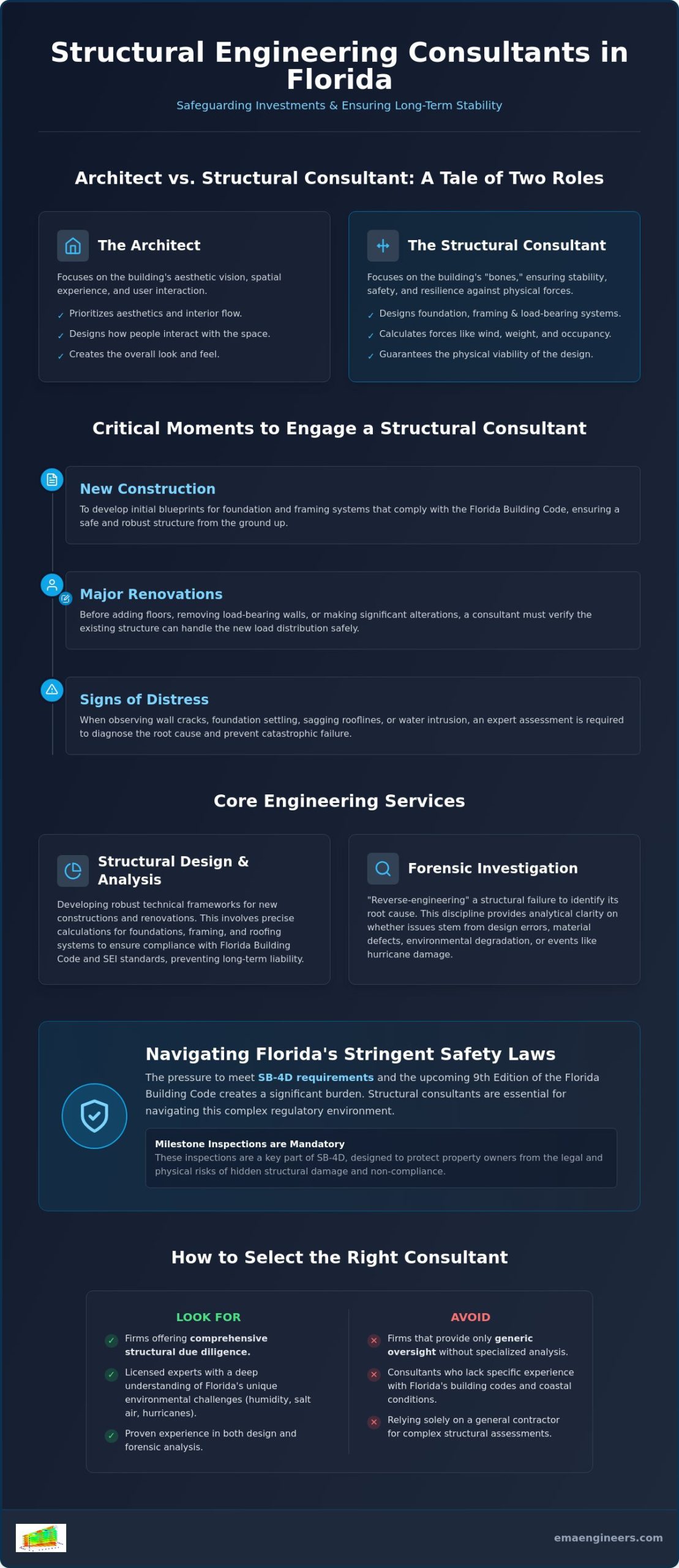
The selection of structural engineering consultants is a critical decision that directly impacts the safety and financial viability of a property. Engaging an unqualified firm often results in more than just technical errors; it can lead to protracted permitting delays, significant legal liabilities, and compromised structural integrity. Property owners must look beyond general engineering capabilities and prioritize firms that emphasize structural due diligence. This specialized focus ensures that every assessment is conducted with an eye toward risk mitigation and long-term asset preservation rather than simple checkbox compliance.
Technical proficiency must be matched by specific project experience. A firm that excels in industrial warehouse design may lack the nuanced understanding required for a high-rise condominium milestone inspection. You should verify that a consultant has a documented history with your specific building type and its unique structural demands. A high-quality consultant also distinguishes themselves through the clarity of their communication. Their reports shouldn’t be buried in impenetrable technical jargon. Instead, they should provide clear, actionable insights that allow owners and boards to make informed decisions regarding repairs and maintenance schedules.
Verification of professional standing for structural engineering consultants is the first step in a disciplined selection process. Every lead engineer on your project must hold a current Professional Engineer (PE) license in the state of Texas. Given the state’s rigorous safety laws, you should also look for specialized certifications, such as designation as a Special Inspector of Threshold Buildings. These credentials signal deeper expertise in high-occupancy structures. Finally, confirm the firm maintains comprehensive professional liability insurance. This protection is a hallmark of a disciplined and accountable partner.
Regional knowledge is indispensable when navigating Florida’s diverse geological and regulatory terrain. For instance, structural engineering consultants. If you’re ready to secure the long-term stability of your building, you can contact our structural experts today to discuss your specific compliance and safety needs.
EMA Structural Forensic Engineers has operated as a technical authority in the Texas market since 2013. This longevity provides a deep institutional knowledge of the state’s evolving regulatory environment and unique geological stressors. As structural engineering consultants, we recognize that a building’s integrity isn’t a static state but a condition that requires continuous, disciplined oversight. Our firm provides a specialized perspective by integrating design proficiency with forensic investigation. This dual capability allows us to identify potential vulnerabilities before they manifest as critical failures, providing property owners with a proactive defense against structural degradation.
We provide this high-stakes technical support across Florida’s major metropolitan hubs, including Tampa, Orlando, Daytona, and West Palm Beach. Our presence in these diverse regions ensures that we understand the specific municipal permitting processes and environmental demands unique to each locale. Whether managing a high-rise on the coast or an industrial facility inland, our team applies the same level of clinical precision to every project.
Our service portfolio is designed to address the specific needs of commercial and multi-family property owners. This includes specialized HUD foundation inspections and comprehensive roof and foundation audits that provide a clinical overview of a structure’s health. In coastal regions, we conduct rigorous window and door threshold inspections to ensure building envelopes meet the stringent requirements for wind and water resistance. Every assessment results in clear, objective reporting designed to satisfy the rigorous standards of both government regulators and insurance carriers. We provide the data-driven clarity required for informed decision-making and long-term risk management.
EMA acts as the “Reliable Guardian” for your physical assets. We understand that property owners face immense pressure from shifting legislation like SB-4D and the upcoming 9th Edition of the Florida Building Code. Our methodical approach to every project ensures that no detail is overlooked, from the initial visual inspection to the final engineering report. By choosing structural engineering consultants with a proven history of technical excellence, you’re investing in the functional longevity of your property. We prioritize functional excellence over superficial fixes, ensuring your building remains a stable and secure environment.
We invite you to experience the security that comes from partnering with a disciplined engineering firm. Whether you require a mandatory milestone inspection, a balcony safety audit, or a hurricane damage assessment, our team is prepared to provide a professional resolution. You can contact EMA today to schedule a structural integrity audit or milestone inspection and ensure your asset remains a safe, compliant, and stable investment for the future.
Maintaining the integrity of a building in Florida requires more than periodic maintenance; it demands a disciplined commitment to technical excellence and regulatory compliance. Evidence demonstrates that professional structural engineering consultants serve as the primary line of defense against environmental degradation and legislative risk. By prioritizing forensic analysis and mandatory milestone inspections, property owners can transform complex safety requirements into a strategic advantage for long-term asset preservation. The path to structural stability is found in clinical precision and proactive oversight.
EMA Structural Forensic Engineers provides the technical authority needed to navigate these high-stakes challenges. As Florida SB-4D compliance experts and licensed threshold inspectors, we bring over 40 years of forensic engineering excellence to every project. We’re here to handle the intricacies of physical infrastructure so you can focus on the growth of your investment. Secure Your Asset with a Professional Structural Assessment from EMA and ensure your property remains a resilient, compliant, and safe environment for years to come.
A structural engineer is a licensed professional who designs and analyzes load-bearing systems, while a structural consultant refers to the advisory role an engineer takes when providing independent oversight or forensic analysis. All structural engineering consultants must be licensed engineers, but the consultant role focuses on strategic guidance, due diligence, and resolving complex technical challenges for property owners rather than just creating initial blueprints.
The cost of professional engineering services is influenced by the building’s complexity, its specific wind zone, and whether the property sits in a designated flood zone. Because coastal structures in High-Velocity Hurricane Zones require more intensive analysis to meet state safety standards, fees are adjusted based on the technical rigor required for the assessment. Each project is evaluated individually to ensure the scope of work matches the building’s specific risk profile.
Structural Inspections are mandatory for condominium and cooperative association buildings that reach three stories in height. According to Florida’s safety legislation, these inspections are generally required once a building reaches 30 years of age. However, buildings located within three miles of the coastline may be subject to these requirements at the 25-year mark, depending on local jurisdictional mandates.
Yes, consultants provide the forensic documentation and technical analysis required to substantiate complex insurance claims following a storm. By performing a hurricane damage assessment, an engineer can distinguish between long-term material degradation and sudden, storm-induced structural failure. This objective evidence is vital for property owners who need to verify the integrity of their building’s load path to insurance carriers.
A comprehensive structural report must include a detailed executive summary of findings, high-resolution photographic evidence of any distress, and the specific engineering calculations used during the assessment. It also needs to provide clear, actionable remedial recommendations to address identified deficiencies. To be legally valid in Florida, the document must be authenticated with the Professional Engineer’s (PE) seal and signature.
While Florida law doesn’t mandate a structural inspection for every commercial transaction, most lenders and institutional investors require one as part of their due diligence process. Identifying latent defects before a sale protects both parties from future legal liabilities and ensures the property’s valuation is accurate. It’s a disciplined step that provides technical certainty in high-value real estate transactions.
The timeline for an assessment varies based on the building’s square footage and the complexity of the structural systems involved. A visual on-site inspection for a standard commercial asset often takes a few hours, while the subsequent data analysis and report generation typically require one to two weeks. Forensic investigations involving non-destructive testing may take longer depending on the depth of the required investigation.
Our firm specializes in commercial assets, multi-family residential buildings, and complex forensic investigations. While we don’t offer residential single-family home design, we do provide specialized forensic services such as HUD foundation inspections and hurricane damage assessments for various property types. We focus our expertise on high-stakes projects where rigorous compliance and technical oversight are essential for long-term stability.